
Hall County Court Calendars Explained
Hall County has no verified single public calendar covering every court. Superior and State settings appear through the case docket and served notices. Probate has a hearing and traffic calendar module in Georgia Probate Records. State traffic arraignments are generally listed for Thursday and Friday, but the exact citation controls. Municipal and federal courts maintain separate schedules.
The Hall civic calendar is not a court docket. Its visible categories concern county departments and public events, with no court-calendar category found during review. The Clerk's legacy calendar link also returned an ODBC architecture error. Neither fact proves that a setting is absent.
Hall Calendar Gaps Need a Clerk
A broken calendar page should change the route, not the conclusion. Search the Hall case in WebCaseManagement, read the latest setting line, then compare it with the document served on the party. If the data conflicts, call the Clerk or Court Administration at 770-532-1895.
For Magistrate, Probate, Juvenile, municipal, or federal matters, contact that court directly. Georgia Courts E-Access is a provider directory, not a universal setting feed. A courthouse terminal can confirm the docket, but it cannot replace a served order or explain a closure.
The legacy Hall calendar returned an ODBC architecture error during research. That is an access failure, not a cancellation. The civic calendar also lacks a visible court-docket category. Search the case, use the correct court module when one exists, and call the assigned office.
Election-day availability orders can affect courthouse operations. Read the date and scope of the current order instead of old news. A delayed opening may not explain each hearing. The assigned judge or clerk must confirm whether the matter starts later, moves, or receives a new setting.
Hall streams list rooms 101, 102, 103, 201, 202, 401, 402, 403, and 404, but availability is status-based. Match a room only after the notice identifies it. Rule 22 bars recording, rebroadcasting, screenshots, photography, and audio or video capture without judicial approval.
Municipal citations use the city court named on the ticket, not one Hall-wide traffic calendar. Gainesville, Braselton, Flowery Branch, and Oakwood publish separate channels. The stop location does not replace the issuing-court field. Call the city clerk when its date or continuance is uncertain.
Finding Your Hall Court Date
Use the case number or citation printed on the newest court paper. For Superior or State Court, enter PublicView at Hall WebCaseManagement, select civil or criminal search, and expand a result with the plus control. Name searches require care because shared names do not prove a match.
- Read the newest citation, summons, notice, or order first.
- Search the correct court portal by case number, citation, or careful name query.
- Expand the docket and note the latest date, time, courtroom, judge, and setting type.
- Call the assigned clerk or visit the counter when the portal is blank or conflicts with the notice.
- Check official NEJC notices for a closure and courthouse postings for day-of changes.
Hall Remote Hearing Windows
The Northeastern Judicial Circuit remote page publishes recurring public Zoom windows: Tuesday criminal hearings, third-Tuesday domestic child-support matters, Wednesday TPO or self-represented domestic matters, and Thursday general hearings, each listed at 9:00 a.m. These are access patterns, not case-specific calendars.
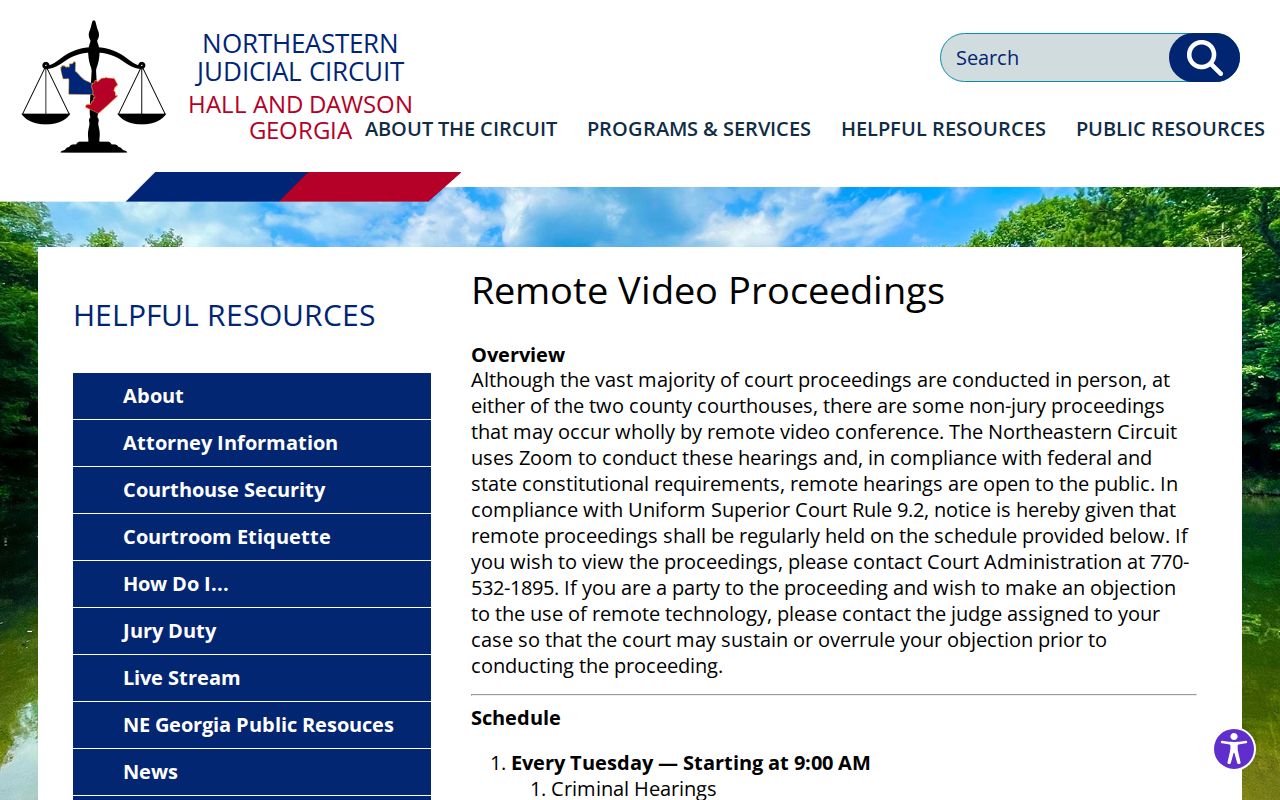
The remote page helps explain how an authorized Hall hearing may be joined, but the assigned judge and current notice determine whether a specific matter is remote. Most proceedings remain in person, and a party may object through the judge.
How to Read a Hall Setting
A complete Hall County setting needs more than a date. Read the time, location, assigned court or judge, and event type together. An arraignment is a plea-setting stage, not automatically a trial. A recurring docket call may group many cases, while a specific order may give an individual time.
| Date | The scheduled day, checked against the newest order. |
|---|---|
| Time | The docket-call or individual start time. |
| Courtroom | The room, floor, building, Zoom route, or other approved location. |
| Judge | The assigned or presiding judicial officer. |
| Setting type | Arraignment, pretrial, motion, general hearing, or trial. |
Hall Courtroom Streams Are Limited
The NEJC live-stream page lists Hall courtroom streams for rooms 101, 102, 103, 201, 202, 401, 402, 403, and 404. Availability is status-based. A stream is not a searchable docket and does not confirm that a named case will be called.
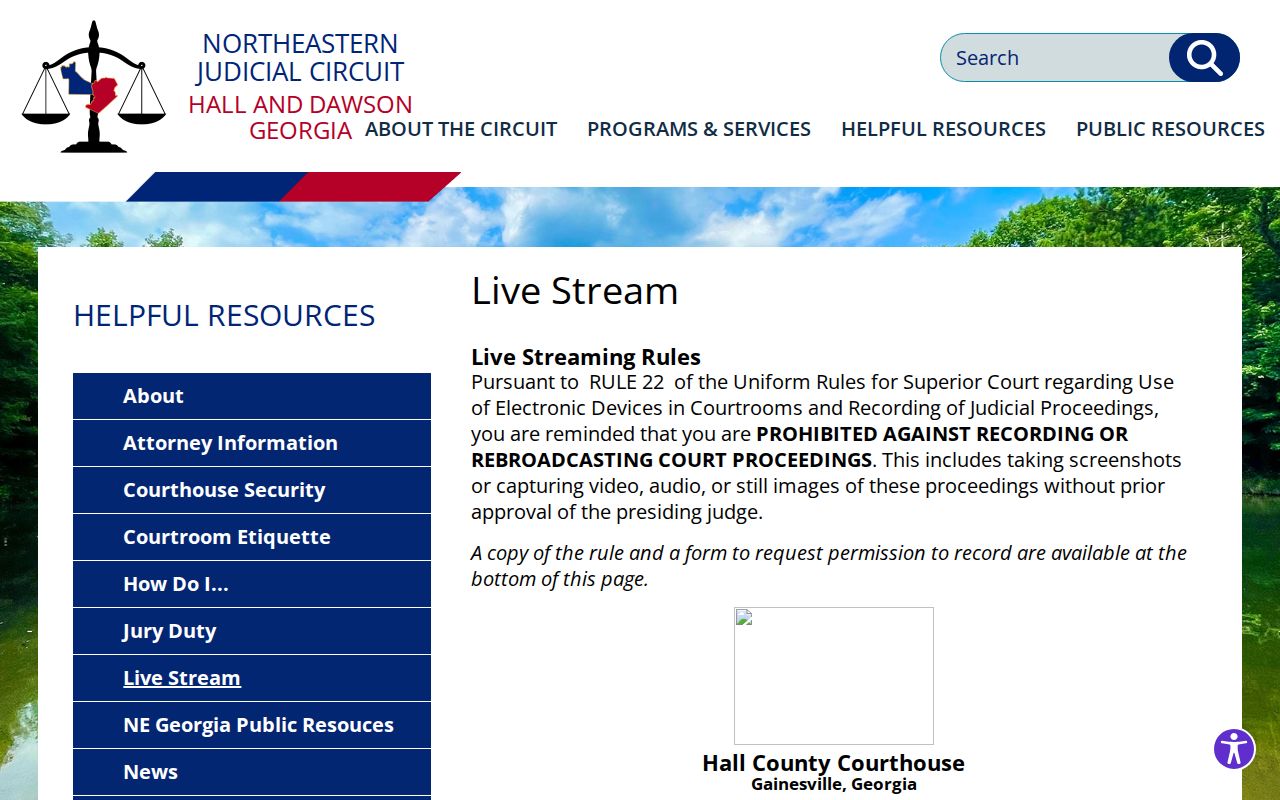
The room list can confirm a public viewing route only after the case setting identifies the courtroom. Georgia Rule 22 bars recording, rebroadcasting, screenshots, photography, and audio or video capture without the presiding judge's approval.
Hall Probate Uses Its Own Calendar
Hall Probate Court has a separate records system for estates, wills, guardianships, marriage records, weapons-license matters, and related proceedings. Georgia Probate Records includes hearing and traffic calendar modules. Hall says most local estate cases after 2010 appear there.
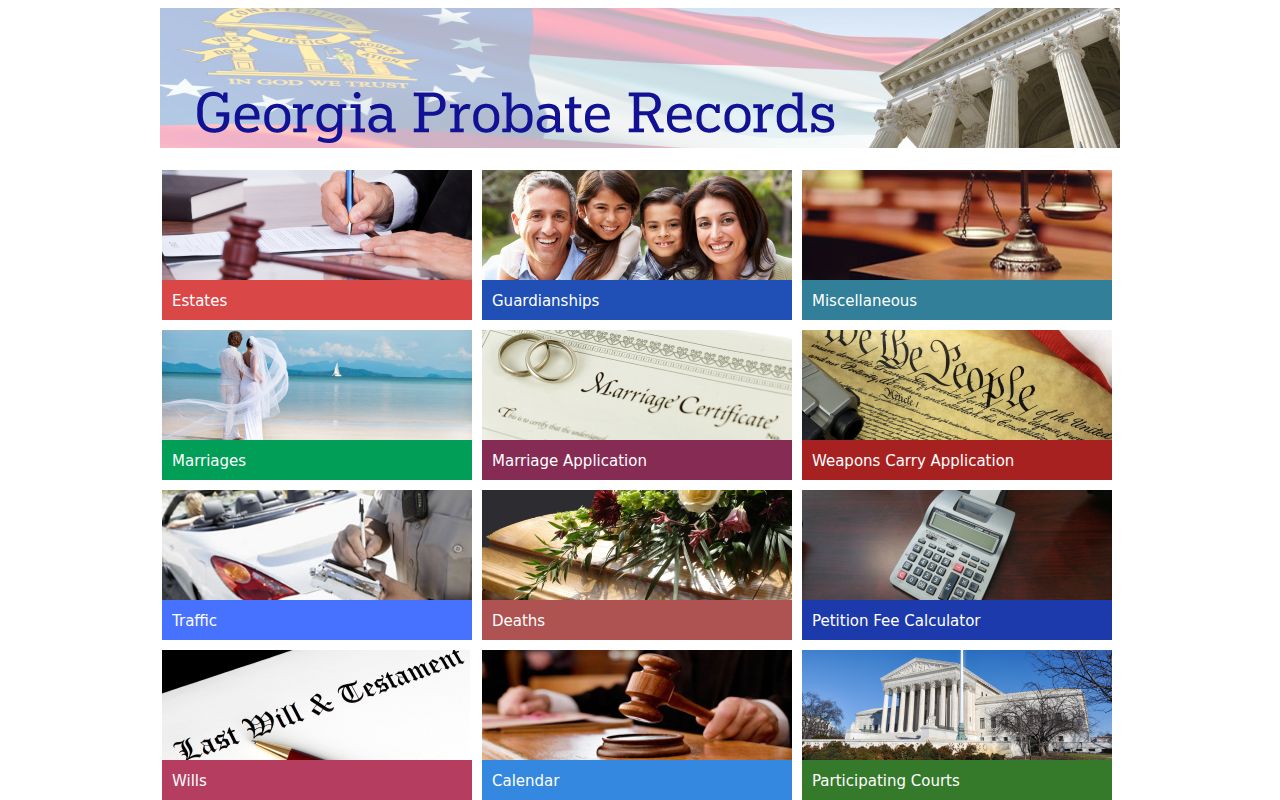
The module shows why a Probate date should not be sought in the Superior and State docket alone. Confirm any returned date with the Probate clerk at 770-531-6921 and the current notice.
Continuances, Resets, and Cancellations
A continuance moves a proceeding. It does not dismiss the case. The Hall docket may add a new event or order, but the older setting can remain in the history. Do not assume that an absent stream or blank calendar means cancellation.
Only the court can confirm the current status. Check the newest docket event, served order, assigned clerk, and official closure notices. A lawyer in the case may also confirm the setting. Court staff can explain the schedule and record route, but cannot advise a party what motion or plea to make.
Hall Weather Notices Can Move Dates
NEJC news posts weather delays, closures, election-day orders, and court notices. A Hall courthouse delay to noon on February 2, 2026 shows why a current alert matters. Such a notice can change access before the online docket is updated.
Check the dated official notice and then contact the assigned clerk. The county civic calendar and NEJC news serve different purposes. Planning materials for the Hall judicial complex also do not announce a new courthouse location or move a pending hearing unless an official court notice says so.
Hall Date Terms in Plain Words
Calendar labels can look alike while serving different purposes. Read each term with the event line and the newest court paper. A filing date records when a pleading entered the case. It does not tell a party when to appear.
- Arraignment
- A scheduled stage for entering a plea, not automatically the trial.
- Setting
- A scheduled court event with a date, time, place, and event type.
- Continuance
- A court-approved move from one setting to another.
- Docket call
- A session in which the court calls multiple matters, sometimes at one listed time.
- Remote hearing
- A proceeding the court authorizes through its stated video route.
When a Hall docket uses a label that is unclear, ask the assigned clerk what the calendar entry means. Court staff may explain the record, though they cannot tell a party how to respond.
A filed date, judgment date, disposition date, and hearing date serve different purposes. The Magistrate civil search even offers separate ranges for filing, judgment, and disposition. None should be substituted for the date on a current summons or order. Confirm the event type as well as the day before appearing.
State traffic arraignment is generally listed on Thursday or Friday, but that pattern is not a personal setting. The citation supplies the exact date and time. Probate's public calendar module and NEJC's recurring remote windows are also court-specific aids, not replacements for an individual notice.
Hall Court Locations Vary
Location is part of the date check. Hall Superior Court is listed on the courthouse fourth floor, while State traffic arraignment uses the first floor. Juvenile Court operates through the Spring Street Annex, and Probate maintains its own office and system. A room number without the right building can send a visitor to the wrong place.
Remote status must also be confirmed. A Zoom window, livestream room, or public link does not turn an in-person setting into a virtual one. Use the latest notice and assigned judge's instructions. Call before travel when an emergency notice, closure, or changed setting creates doubt.
If You Miss a Hall Setting
Contact the maintaining Hall court at once. Give the case number, court, scheduled date, and event type. Ask whether an order, failure-to-appear entry, warrant, or new setting has been filed. Do not rely on a payment page or old calendar line to resolve the missed event.
Missed a setting? A missed required appearance can lead to a failure-to-appear entry, added consequences, or a bench warrant.
Call the Hall clerk or court immediately and contact your lawyer if represented.
Only the court can confirm whether a new date has been set or another action is required.
For State Court traffic cases, Hall warns that failure to appear may lead to a fee, license-suspension action, or warrant. Current Hall and older NEJC pages conflict on the fee amount, so confirm it instead of relying on a quoted figure.