
Searching Hall County Civil Dockets
Superior and State cases begin at Hall Courts WebCaseManagement. Enter PublicView, choose Civil Search, and use a case number or careful party-name query. The form also accepts a CSE number, System Wide Search text, filed dates, and case-category filters.
Hall Magistrate claims use Georgia Magistrate Records. The Clerk lobby terminal, Civil Division at 770-503-3217, main Clerk line at 770-531-7025, and Magistrate line at 770-531-6912 provide fallbacks.
- Identify Superior, State, or Magistrate Court.
- Open that court's search and enter one reliable criterion.
- Narrow by category or dates only when needed.
- Expand the match and compare parties, court, status, and filings.
- Ask the maintaining clerk for the filed judgment or a certified copy.
Hall Civil Portal Fields
The Hall County civil docket form serves several case groups. A case number gives a tighter result than a shared party name. The CSE field is for a child-support-enforcement identifier and should be kept private. Filed dates are not service or hearing dates.
| Control | Use | Limit |
|---|---|---|
| Case # | Known Hall file | No universal format is published |
| Party Name | Named-party query | Confirm court and case facts |
| CSE # | Child-support file | Do not publish it |
| Category | Domestic, Superior, Child Support, State, Habeas | Not an outcome |
| Filed dates | Narrow the filing period | Not the setting date |
Click the plus control beside a case number to expand its docket. An empty result can reflect the wrong court, an old record, spelling variation, restricted filing, or indexing delay.
Inside a Hall Civil Docket
A Hall County civil docket is the chronological register. It can identify parties, category, filing data, status, motions, orders, settings, and disposition. The event line and filed image are separate. Image-cart controls do not promise that every document is public.
| Case number | The court's identifier for the filed matter. |
|---|---|
| Parties | Names and roles in the public index, subject to restrictions. |
| Filings | Complaint, petition, answer, service, motion, order, or event. |
| Setting | A hearing entry checked against the latest notice. |
| Judgment | The stated final order, dismissal, default, or disposition. |
Hall Magistrate Civil Search
Hall Magistrate handles claims generally worth $15,000 or less, dispossessories, garnishments, property foreclosures, abandoned property, and interrogatories. Its vendor form requires Hall County and at least one criterion. Filing types include Statement of Claim, Dispossessory, Garnishment, Foreclosure, Abandoned Property, Abandoned Vehicle, Interrogatories, and Mechanic's Lien.
The official civil search interface accepts names, case number, and filing, judgment, or disposition ranges.
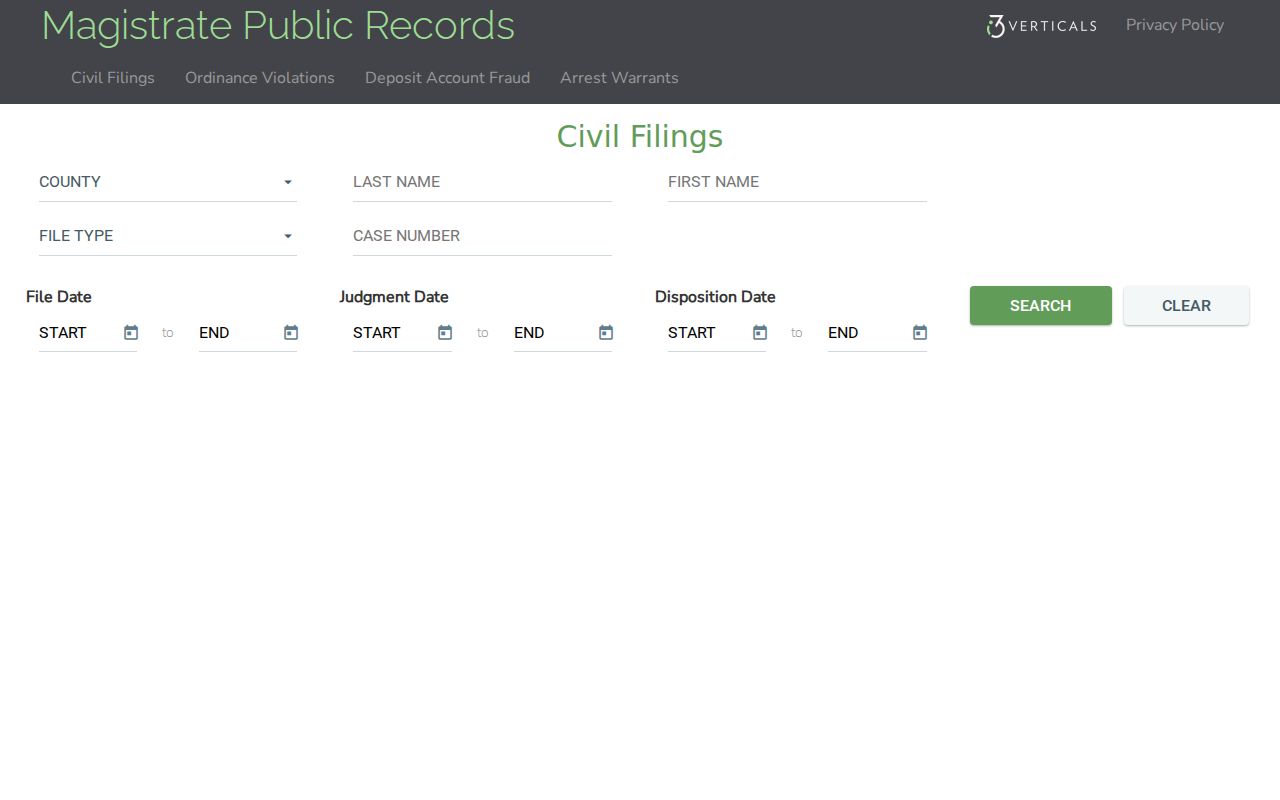
The county and filing controls direct a Hall small-civil query without replacing the clerk's complete file.
Civil Case Types on the Docket
Hall County divides civil work by jurisdiction. Superior Court handles equity, domestic relations, major civil actions, and real-property issues. State Court handles non-equity civil cases. Magistrate Court covers limited civil categories. Probate and Juvenile files stay with separate clerks.
- Superior civil, domestic, child support, and habeas matters
- State Court non-equity civil actions
- Magistrate statements of claim and dispossessories
- Garnishments, foreclosures, and abandoned-property matters
- Separate Probate and Juvenile records where jurisdiction applies
Hall Civil Filing Went Digital
Mandatory civil e-filing began in Hall Superior and State Courts on October 1, 2022. PeachCourt is the authorized provider. Exceptions include qualifying incarcerated or self-represented filers, sealed matters, adoptions, protective orders, and other approved circumstances.
E-filing is not public docket searching. PeachCourt supplies filing accounts, while WebCaseManagement supplies the public view. The 2022 notice described free Clerk-lobby terminals and a waived nominal e-access fee there. Confirm current pricing. Magistrate uses eFile Georgia for eligible filings and stamps a submission when the clerk accepts it, not when first sent.
Hall Dispossessory and Garnishment Routes
A Hall County dispossessory or garnishment is not just another Superior or State civil category. Magistrate Court supplies local forms and accepts eligible Statement of Claim, dispossessory, and answer filings through eFile Georgia. The vendor may charge a convenience fee. A filing is date-stamped when the clerk accepts it, which can differ from the time it was first uploaded.
The dispossessory form includes possession, past-due rent, daily-rent, demand, and service fields. Its summons carries the governing answer deadline. Garnishment uses distinct forms, service, and answer rules. Search the Magistrate civil docket by the correct filing type, then confirm a filed answer or judgment with the clerk. Forms show required fields but do not decide what a person should claim.
Older matters, paper exceptions, non-participating categories, and restricted filings may not appear in the vendor search. The Hall Magistrate counter remains the record source. Civil clerks can explain filing status and copy routes, but they cannot give legal advice.
Hall Civil Docket Settings
A civil docket can record a hearing, conference, motion setting, continuance, or order, but the newest summons, served notice, or court order controls. Filed date and hearing date are different. A reset may appear as a later event, though delay can leave an old setting visible.
Hall has no verified unified public court calendar. Confirm through the expanded docket and assigned clerk. Some non-jury NEJC hearings use published Zoom windows, but those are not personal calendars. The Hall County court-date process covers other checks.
Hall Magistrate Filing Costs
Hall's July 2024 schedule separates filing, service, extra parties, copies, and later steps. A Statement of Claim is $110 for one defendant and $160 for two, with $50 for added service or a defendant. A dispossessory is $85 for one and $110 for two, with $25 for added service. Garnishment is $110 for garnishee-only service and $160 when both garnishee and defendant service apply.
| Item | Published amount |
|---|---|
| Late Answer | $20 |
| Regular copy | $0.25 |
| Certified copy | $3 |
| 2010-2018 storage scan | $10 |
Fees can change. Ask the Hall clerk for a current total because service, more parties, certification, or vendor charges can add cost.
The listed filing amount is not always the full case cost. Sheriff service, another defendant, out-of-county service, a vendor convenience charge, certification, a writ, or later collection work can add separate amounts. Identify the filing and service plan when asking the Magistrate clerk for an estimate.
Hall Docket Lines Are Not Documents
A Hall County civil docket line proves only what the public register states. It may show that a complaint, return of service, motion, answer, order, or judgment was entered. It does not reproduce every fact inside that document. A restricted image may still leave a public event line, and a redacted public copy may differ from the sealed original.
For a plain or certified copy, give the clerk the court, case number, document title, and approximate filing date. Certification is a clerk act that verifies the copy against the court file. It is not the same as downloading an image from a cart. If the request involves another custodian, such as Probate Court, route it there instead of assuming the Superior and State Clerk holds it.
Hall Civil Requests Stay Narrow
Hall County's records process works best when a request identifies an existing record. State the exact court, civil case number if known, document type, date range, and preferred electronic or paper format. Ask for a cost estimate before authorizing broad research.
Hall says a custodian decides within three business days whether a record is readily available or needs research. The first fifteen minutes of staff time are free, then the lowest qualified employee's rate may apply. Paper letter or legal pages are listed at ten cents, apart from court certification charges. These open-record figures do not replace a court's current copy schedule.
A request for a docket register differs from a request for all filed images. Name the complaint, answer, motion, order, judgment, or disposition if that is the item needed. This gives the office a sound basis for a fee estimate. Hall is not required to create a new summary or analysis.
The acceptance point matters when reading an electronic filing. A file sent to a vendor may not yet be an official event. Check the clerk's file stamp and expanded docket rather than an upload receipt. Sealed, adoption, and protective-order filings may use an exception route.
Domestic, child-support, habeas, adoption, and protective-order records can raise different access questions. A category box is not permission to publish every identifier. Rule 21.6 and Georgia law protect specified personal data, and an order may restrict more. Ask for the public version of the exact filing instead of reconstructing sealed content from event labels.
Hall Civil Docket Access Rules
Georgia court records are generally open unless law, rule, procedure, or order limits access. Hall says most documents are public but some are restricted. Adoptions, sealed domestic matters, protective orders, juvenile records, and protected identifiers need special care. A visible event does not make every attachment public.
Key rules:
Uniform Superior Court Rules 21 and 21.6 address access, restrictions, and identifiers.
Hall County records guidance routes court requests to the proper court department.
Name the Hall court, case number, record type, range, and format. Ask for an existing docket, pleading, order, judgment, or certified copy. If withheld, request the legal or court-order basis. The clerk can also identify the correct division when custody is uncertain. Confirm all fees before ordering copies.